Rise of the Giant Telescopes

The biggest telescope ever constructed, the Thirty Meter Telescope (TMT), officially broke ground on Mauna Kea in Hawai’i on Tuesday. Building on technology used for the Keck telescopes, the TMT’s primary mirror will be segmented combining 492 hexagonal reflectors that will be honeycombed together, and it will have an effective diameter of 30 meters, as you’ve probably guessed. (Astrophysicists come up with very descriptive names for their telescopes and simulations.) 30 meters is really really big—about a third the length of an American football field and nearly the size of a baseball diamond’s infield. When it’s built it will look something like this:

url

(If you’re interested, here’s a shameless plug: we discussed the TMT’s groundbreaking on the Weekly Space Hangout with Universe Today yesterday, and you can see the video on YouTube.)

The groundbreaking and blessing ceremony, which included George Takei hosting a live webcast, didn’t go quite as planned. It was disrupted by a peaceful protest of several dozen people who oppose the telescope’s construction. The protesters chanted and debated with attendees and held signs with “Aloha ‘Aina” (which means ‘love of the land’) and using TMT to spell out “Too Many Telescopes.” There has been a history of tension over what native Hawaiians say is sacred ground in need of protection and is also one of the best places on Earth to place telescopes. This is a longstanding issue, and the tension between them back in 2001 was reported in this LA Times article. According to Garth Illingworth, co-chair of the Science Advisory Committee, “It was an uncomfortable situation for those directly involved, but the way in which the interactions with the protesters was handled, with considerable effort to show respect and to deal with the situation with dignity, reflected credit on all concerned.” In any case, construction will continue as planned.

20141008_015_MAUNAKEA_PROTESTS

The TMT’s science case includes observing distant galaxies and the large-scale structure of the early universe, and will enable new research on supermassive black holes, and star and planet formation. The TMT is led by researchers at Caltech and University of California (where I work), and Canada, Japan, China, India. Its optical to near-infrared images will be deeper and sharper than anything else available, with spatial resolution twelve times that of the Hubble Space Telescope and eight times the light-gathering area of any other optical telescope. If it’s completed on schedule, it will have “first light” in 2022 and could be the first of the next generation of huge ground-based telescopes. The others are the European Extremely Large Telescope (E-ELT, led by the European Southern Observatory) and the Giant Magellan Telescope (GMT, led by the Carnegie Observatories and other institutions), which will be located in northern Chile.

Every ten years, astronomers and astrophysicists prioritize small-, medium-, and large-scale ground-based and space-based missions, with the aim of advising the federal government’s investment, such as funding through the National Science Foundation (NSF) and NASA. The most recent decadal survey, conducted by the National Academy of Sciences is available online (“New Worlds, New Horizons in Astronomy and Astrophysics“). For the large-scale ground-based telescopes, the NSF will be providing funding for the Large Synoptic Survey Telescope (which I’ve written about here before) and the TMT. There had been debates about funding either the TMT or the GMT, but not both, though a couple years ago GMT scientists opted out of federal funding (see this Science article). NASA is focusing on space-based missions such as the upcoming James Webb Space Telescope (JWST) and Wide-Field InfraRed Survey Telescope (WFIRST), which will be launched later this decade.

Is “Data-driven Science” an Oxymoron?

In recent years, we’ve been repeatedly told that we’re living and working in an era of Big Data (and Big Science). We’ve heard how Nate Silver and others are revolutionizing how we analyze and interpret data. In many areas of science and in many aspects of life, for that matter, we’re obtaining collections of datasets so large and complex that it becomes necessary to change our traditional analysis methods. Since the volume, velocity, and variety of data are rapidly increasing, it is increasingly important to develop and apply appropriate techniques and statistical tools.

However, is it true that Big Data changes everything? Much can be gained from proper data analysis and from “data-driven science.” For example, the popular story about Billy Beane and Moneyball shows how Big Data and statistics transformed how baseball teams are assessed. But I’d like to point out some misconceptions and dangers of the concept of data-driven science.

Governments, corporations, and employers are already collecting (too?) much of our precious, precious data and expending massive effort to study it. We might worry about this because of concerns of privacy, but we should also worry about what might happen to analyses that are excessively focused on the data. There are questions that we should be asking more often: Who’s collecting the data? Which data and why? Which analysis tools and why? What are their assumptions and priors? My main point will be that the results from computer codes churning through massive datasets are not objective or impartial, and the data don’t inevitably drive us to a particular conclusion. This is why the concept of “data-driven” anything is misleading.

Let’s take a look at a few examples of data-driven analysis that have been in the news lately…

Nate Silver and FiveThirtyEight

Many media organizations are about something, and they use a variety of methods to study it. In a sense, FiveThirtyEight isn’t really about something. (If I wanted to read about nothing, I’d check out ClickHole and be more entertained.) Instead, FiveThirtyEight is about their method, which they call “data journalism” and by which they mean “statistical analysis, but also data visualization, computer programming and data-literate reporting.”

I’m exaggerating though. They cover broad topics related to politics, economics, science, life, and sports. They’ve had considerable success making probabilistic predictions about baseball, March Madness, and World Cup teams and in packaging statistics in a slick and easy-to-understand way. They also successfully predicted the 2012 US elections on a state-by-state basis, though they stuck to the usual script of treating it as a horse race: one team against another. Their statistical methods are sometimes “black boxes”, but if you look, they’ll often provide additional information about them. Their statistics are usually sound, but maybe they should be more forthcoming about the assumptions and uncertainties involved.

Their “life” section basically allows them to cover whatever they think is the popular meme of the day, which in my opinion isn’t what a non-tabloid media organization should be focused on doing. This section includes their “burrito competition,” which could be a fun idea but their bracket apparently neglected sparsely-populated states like New Mexico and Arizona, where the burrito historically originated.

The “economics” section has faced substantial criticism. For example, Ben Casselman’s article, “Typical minimum-wage earners aren’t poor, but they’re not quite middle class,” was criticized in Al-Jazeera America for being based on a single set of data plotting minimum-wage workers by household income. He doesn’t consider the controversial issue of how to measure poverty or the decrease in the real value of the minimum wage, and he ends up undermining the case for raising the minimum wage. Another article about corporate cash hoarding was criticized by Paul Krugman and others for jumping to conclusions based on revised data. As Malcolm Harris (an editor at The New Inquiry) writes, “Data extrapolation is a very impressive trick when performed with skill and grace…but it doesn’t come equipped with the humility we should demand from our writers.”

Their “science” section leaves a lot to be desired. For example, they have a piece assessing health news reports in which the author (Jeff Leek) uses Bayesian priors based on an “initial gut feeling” before assigning numbers to a checklist. As pointed out in this Columbia Journalism Review article, “plenty of people have already produced such checklists—only more thoughtfully and with greater detail…Not to mention that interpreting the value of an individual scientific study is difficult—a subject worthy of much more description and analysis than FiveThirtyEight provides.” And then there was the brouhaha about Roger Pielke, whose writings about the effects of climate change I criticized before, and who’s now left the organization.

Maybe Nate Silver should leave these topics to the experts and stick to covering sports? He does that really well.

Thomas Piketty on Inequality

Let’s briefly consider two more examples. You’ve probably heard about the popular and best-selling analysis of data-driven economics in Thomas Piketty’s magnum opus, Capital in the Twenty-first Century. It’s a long but well-written book in which Piketty makes convincing arguments about how income and wealth inequality are worsening in the United States, France, and other developed countries. (See these reviews in the NY Review of Books and Slate.) It’s influential because of its excellent and systematic use of statistics and data analysis, because of the neglect of wealth inequality by other mainstream economists, and of course because of the economic recession and the dominance of the top 1 percent.

Piketty has been criticized by conservatives, and he has successfully responded to these critics. His proposal for a progressive tax on wealth has also been criticized by some. Perhaps the book’s popularity and the clearly widespread and underestimated economic inequality will result in more discussion and consideration of this and other proposals.

I want to make a different point though. As impressive as Piketty’s book is, we should be careful about how we interpret it and his ideas for reducing inequality. For example, as argued by Russell Jacoby, unlike Marx in Das Kapital, Piketty takes the current system of capitalism for granted. Equality “as an idea and demand also contains an element of resignation; it accepts society, but wants to balance out the goods or privileges…Equalizing pollution pollutes equally, but does not end pollution.” While Piketty’s ideas for reducing economic extremes could be very helpful, they don’t “address a redundant labor force, alienating work, or a society driven by money and profit.” You may or may not agree with Piketty’s starting point—and you do have to start somewhere—but it’s important to keep it in mind when interpreting the results.

As before, just because something is “data-driven” doesn’t mean that the data, analysis, or conclusions can’t be questioned. We always need to be grounded in data, but we need to be careful about how we interpret analyses of them.

HealthMap on Ebola

Harvard’s HealthMap gained attention for using algorithms to detect the beginning of the Ebola outbreak in Africa before the World Health Organization did. Is that a big success for “big data”? Not so, according to Foreign Policy. “It’s an inspirational story that is a common refrain in the ‘big data’ world—sophisticated computer algorithms sift through millions of data points and divine hidden patterns indicating a previously unrecognized outbreak that was then used to alert unsuspecting health authorities and government officials…The problem is that this story isn’t quite true.” By the time HealthMap monitored its very first report, the Guinean government had actually already announced the outbreak and notified the WHO. Part of the problem is that it was published in French, while most monitoring systems today emphasize English-language material.

This seems to be another case of people jumping to conclusions to fit a popular narrative.

What does all this mean for Science?

Are “big data” and “data-driven” science more than just buzzwords? Maybe. But as these examples show, we have to be careful when utilizing them and interpreting their results. When some people conduct various kinds of statistical analyses and data mining, they act as if the data speak for themselves. So their conclusions must be indisputable! But the data never speak for themselves. We scientists and analysts are not simply going around performing induction, collecting every relevant datum around us, and cranking the data through machines.

Every analysis has some assumptions. We all make assumptions about which data to collect, which way to analyze them, which models to use, how to reduce our biases, and how to assess our uncertainties. All machine learning methods, including “unsupervised” learning (in which one tries to find hidden patterns in data), require assumptions. The data definitely do not “drive” one to a particular conclusion. When we interpret someone’s analysis, we may or may not agree with their assumptions, but we should know what they are. And any analyst who does not clearly disclose their assumptions and uncertainties is doing everyone a disservice. Scientists are human and make mistakes, but these are obvious mistakes to avoid. Although objective data-driven science might not be possible, as long as we’re clear about how we choose our data and models and how we analyze them, then it’s still possible to make progress and reach a consensus on some issues and ask new questions on others.


Exploring Physics with Intertribal Youth at UCSD

[This is about a physics outreach event at UC San Diego this summer, and it will be published in the UCSD Fall Newsletter. Many thanks to Susan Brown for editing assistance.]

How does a speaker system work? Why do figure skaters spin faster when they draw in their arms and legs? Where does static electricity come from? How much energy does a lightbulb use? Native American students asked these kinds of questions on Friday, July 25th, as they participated in a physics outreach event at UC San Diego.

As part of a two-week visit to UCSD, San Diego State, and Cal State San Marcos, twenty five middle and high school students traveled to campus on Friday morning to engage in hand-on activities and demonstrations with physics researchers, postdocs, and grad students. They’re part of Intertribal Youth, a fourteen year-old organization directed by Marc Chavez and based in California with the purpose of enriching the lives of young students.

1919642_873195802693960_7651083376894096576_n

The event on Friday was primarily organized by Adam Burgasser, an associate professor of physics, and Dianna Cowern, an outreach coordinator, both at the Center for Astrophysics & Space Sciences. Adam, who has worked extensively on outreach and diversity programs, contacted the ITY group through the UCSD Office of Equity, Diversity and Inclusion, which resulted in this event at Mayer Hall (Revelle College) and other planned outreach events.

We planned demonstrations in five physics areas, including electricity and magnetism, vibration and sound, optics and light, solar energy, and momentum. Unfortunately, we had to skip the solar energy one because it was surprisingly cloudy for San Diego—the marine layer persisted all morning. We divided the students into four groups, and they spent about twenty five minutes exploring and learning about each of the other topics.

Drew Nguyen and I facilitated demonstrations on Mayer Hall’s balcony on linear and angular momentum, including an air rocket, a rotating chair and hand-crank bicycle wheel, and a basketball and tennis ball. Students discovered that it’s easy to make a simple rocket: we held a 2-liter plastic Coke bottle on a wooden base, poured in a little water and pumped in air with a bike pump, and then let go and watched it take off and fly a couple stories into the air! (I got a bit wet as water spurted out the bottom.) Students experimented with it and some were surprised that without the water to keep the air pressure high, the bottle had no thrust and remained grounded.

10502158_873195696027304_9069725977082057591_n

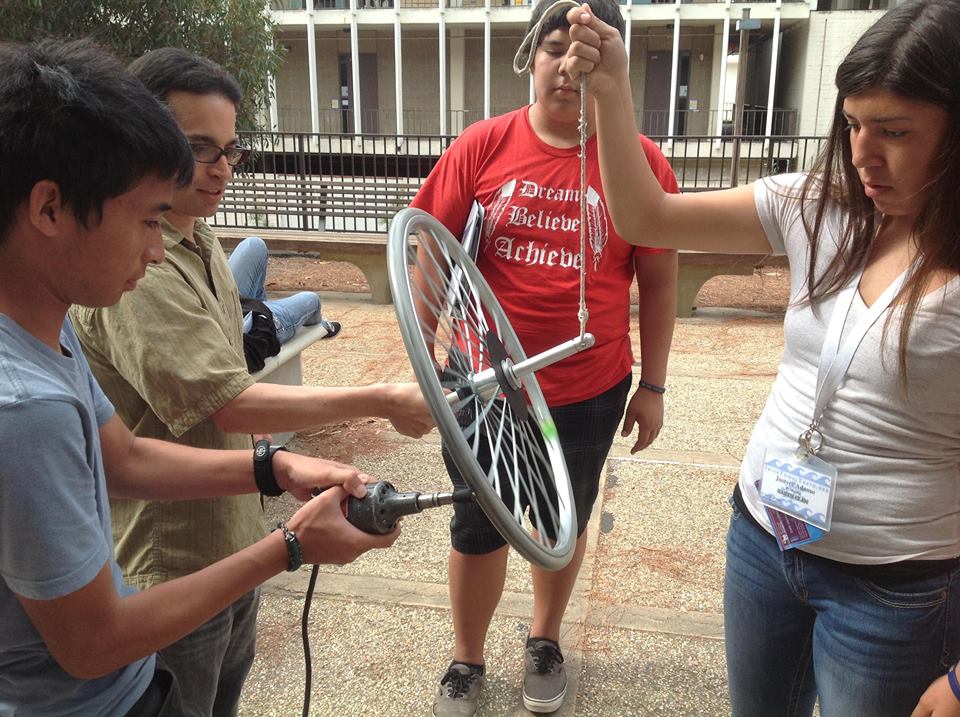
In another demo, students would spin each other on a rotating stool while keeping their arms extended. Then when the seated person brings in their arms, they rotate faster, just like a rapidly spinning figure skater, which demonstrated the conservation of angular momentum. In a related demo, we hung a bike wheel from a rope attached to its axis, and when it’s spinning rapidly, it could spin vertically or tilted, and the person holding the rope could feel the momentum of the wheel. This demo always impressed students, such as Marla and Dakota. Dakota thought it was “crazy and weird” that the wheel would rotate this way, until he and the other students figured it out. Marla realized that it’s the same principle that keeps a tilted bike from falling over when someone’s riding around a curve in the road.

The students enjoyed playing with these and other demos. For example, inside Mayer Hall, they explored a bunch of experiments related to electricity and magnetism. They particularly enjoyed the van de Graaff generator, which is a hollow metal globe on top of a stand and which uses a moving belt to generate static electricity. When you touch it with particular rods, which might be like lightning rods, it generates sparks—and the students sometimes shocked each other too. But touching the globe with your own hand makes your hair stand on end. It was hard to tear the students away from these exciting experiments and continue with them all over the course of the morning.

During those couple hours, they actively learned a couple things about physics and engaged with real-life scientists. These outreach events help to spark the students’ interest in science, and particularly in physics and astronomy, and we hope to inspire a few of them will be inspired to pursue science further as they continue their education and become the next generation of scientists.

After the demonstrations, everyone loved the liquid nitrogen ice cream, which Adam and the students made on the patio. It tastes a lot like regular ice cream, but it’s much more fun. Over the rest of their visit, the ITY students enjoyed other activities in the San Diego region including a “star party” at the La Jolla Indian Reservation on the following Tuesday night.

People’s Climate March in San Diego

Yesterday afternoon was hot, sunny, and dry in southern California, and it was as great a time as any to draw attention to climate change and demand action on it. I was one of 1,500 people who participated in the People’s Climate March and rally in San Diego, which started at City Hall and the Civic Center, went down Broadway past the train station, and ended at the County Administration Park.

09.21.14_civic_center_crowd_t670_t658

It was exciting and inspiring to be involved in what may have been the largest climate protest in history. At least 300,000 people participated in the march in New York, where the UN climate summit is taking place. According to a speaker for SanDiego350, which was one of the groups organizing the local events, there were marches and rallies in over 3000 cities around the world. They were also widely reported in the media, for example in the New York Times, LA Times, Guardian, and Democracy Now. I’m not a good photographer, so I grabbed the photo above from the SD Reader and the NYC photo below came from the Guardian. I’m sure there were a few differences between the people participating in the SD and NYC protests, as I saw many people wearing flip-flops, heard chants of “¡Si Se Puede!”, and saw a few Mexican wrestler masks too.

63a815be-5a7d-481b-8ac5-1aec638c70e6-680x1020

From what I could see, it was a very diverse crowd in terms of gender, race, class, and age. Climate change is now more than just an environmental issue—many people from unions, religious groups, and students and teachers attended too. People held signs and yelled chants saying a variety of things: demands for clean energy, green jobs, climate justice, and an end to fracking were common. As I mentioned in my previous post, many Californians are concerned about drought and water policies too, and I saw a few signs about these issues as well. Although we can see widespread support for action on climate change, it’s clear that conservatives and Republicans didn’t show up; climate change has become an increasingly partisan issue in the US over the past few years.

Organizers had great speakers and musicians at the beginning, middle, and end of the march. Many political leaders attended, including Rep. Susan Davis, the Congressional representative for our district. Speakers included: Todd Gloria, City Council president and former interim mayor, who gave a rousing speech to kick off the march; Nicole Capretz, Director of Environmental Policy for the city, who cited labor, women’s rights, and civil rights movements as inspiration; Monique Lopez, Environmental Health Coalition advocate, and City Council member David Alvarez. (More details about the speakers are here.)

Capretz and Gloria outlined their Climate Action Plan, which includes ambitious goals in five areas: energy and water efficient buildings; clean and renewable energy; biking, walking, and transit; zero waste; and climate resiliency. From what I can tell, their emphasis is on the first three prongs. The plan would cut San Diego’s greenhouse gas emissions by 15% by 2020 and nearly half by 2035. More than half of San Diego’s GHG emissions come from transportation, which is why investment in public transit, bike- and pedestrian-friendly areas, incentives for car-pooling, and other related measures are important. However, the plan already faces some resistance from business groups, who only approve of voluntary, incentive-based programs (but not mandatory measures) to get property owners to pursue upgrades to improve buildings’ water and energy efficiency. Mayor Kevin Faulconer is preparing to release his own version of the plan. If it’s watered down, I think he can expect San Diegans to organize more climate marches in the future.

[Although I’m a scientist and always try to lay out the facts in my blog posts, I want to be clear that I’m speaking my personal opinions here.]

Californians and the Environment

The Public Policy Institute of California (PPIC), a nonprofit, nonpartisan thinktank based in San Francisco, recently conducted a survey of Californians’ views of environmental issues. This is particularly important in light of the ongoing drought in the southwest and the upcoming elections in November. According to the report (available in PDF format), the results are based on the responses of 1,705 adult residents throughout California, interviewed in English and Spanish by landline or cell phone, and they’re estimated to have a sampling error of 4% (at the 95% confidence level). I’ll describe what I see as their most interesting results, and if you want more information, I encourage you to read the report.

Global warming: A strong majority say they are very concerned (40%) or somewhat concerned (34%) about global warming. Approximately two thirds of Californians (68%) support the state law, AB 32, which requires California to reduce its carbon emissions to 1990 levels by 2020, but the partisan divide (Democrats at 81% vs Republicans at 39%) has grown on this issue. 80% of Californians say that global warming is a very serious or somewhat serious threat to the economy and quality of life for California’s future. Only 45% of people are aware at all about the state’s cap-and-trade system, which took effect in 2012, but after being read a brief description, Californians are more likely to favor (51%) than oppose (40%) the program. Under a recent agreement between the governor and legislature, 25% of the revenues generated by the cap-and-trade program will be spent on high-speed rail, 35% on other mass transit projects and affordable housing near transit, and the rest for other purposes.

graph

Energy policies: overwhelming majorities of adults favor requiring automakers to significantly improve the fuel efficiency of cars sold in the U.S. (85%) and increasing federal funding to develop wind, solar, and hydrogen technology (78%). Strong majorities support the requirement that oil companies produce cleaner transportation fuels and the goal that a third of California’s electricity come from renewable energy sources. But residents’ support declines significantly if these two efforts lead to higher gas prices or electricity bills. (This is unfortunate, because gas and oil companies are heavily subsidized in the US, and maybe our gas and electricity bills are too low.) Most residents (64%) oppose building more nuclear power plants, as they have since the Fukushima disaster.

The survey includes other contentious issues: 54% of Californians oppose hydraulic fracturing, or fracking, for oil and natural gas extraction. But a majority (53%) support building the Keystone XL pipeline.

Water policies: Asked about some of the possible effects of global warming in California, majorities say they are very concerned about droughts (64%) or wildfires (61%) that are more severe. 35% say that water supply or drought is the most important environmental issue facing the state today (which is 27% higher than the fraction in a 2011 survey), and this is the first environmental survey in which air pollution was not the top issue. In another measure of concern about drought, strong majorities of residents (75%) say they favor their local water districts requiring residents to reduce water use. The CA legislature is discussing a $11.1 billion state bond for water projects that is currently on the November ballot, and a slim majority of likely voters would support it (51% yes, 26% no).

If you’re interested, the PPIC has useful information and publications on water policies and management of resources: see this page and this blog post series. Water policy analysts argue that in the Central Valley, where most agricultural water use occurs, the failure to manage groundwater sustainably limits its availability as a drought reserve. In urban areas, the greatest potential for further water savings lies in reducing landscaping irrigation—a shift requiring behavioral changes, not just the adoption of new technology. Finally, state and federal regulators must make tough decisions about how and when to allocate water during a drought: they must balance short-term economic impacts on urban and agricultural water users against long-term harm—even risk of extinction—of fish and wildlife.

People’s Climate March

This is a different topic and has nothing to do with the survey, but I want to use this opportunity to plug the People’s Climate March, which will be taking place on Sunday. (This website can direct you to events in your area.) One of the biggest marches and rallies will be in New York City, where the UN climate summit will soon be taking place. Even Ban Ki-moon will be participating! For San Diegans, you can find information about Sunday’s downtown events here. Californians also organized a “People’s Climate Train” to take activists and participants by train from the Bay Area through Denver and Chicago to New York, where they’ll be arriving tonight. Finally, I recommend reading this well written piece by Rebecca Solnit on Dr. Seuss’s The Lorax and the need to raise our voices on Sunday.

Astrophysicists Gather in Aspen to Study the Galaxy-Dark Matter Connection

I just returned from a summer workshop at the Aspen Center for Physics, and I enjoyed it quite a bit! The official title of our workshop is “The Galaxy-Halo Connection Across Cosmic Time.” It was organized by Risa Wechsler (Stanford) and Frank van den Bosch (Yale) and others who unfortunately weren’t able to attend (Andreas Berlind, Jeremy Tinker, and Andrew Zentner). The workshop itself was very well attended by researchers and faculty from a geographically diverse range of institutions, but since it was relatively late in the summer, a few people couldn’t come because of teaching duties.

photo 1

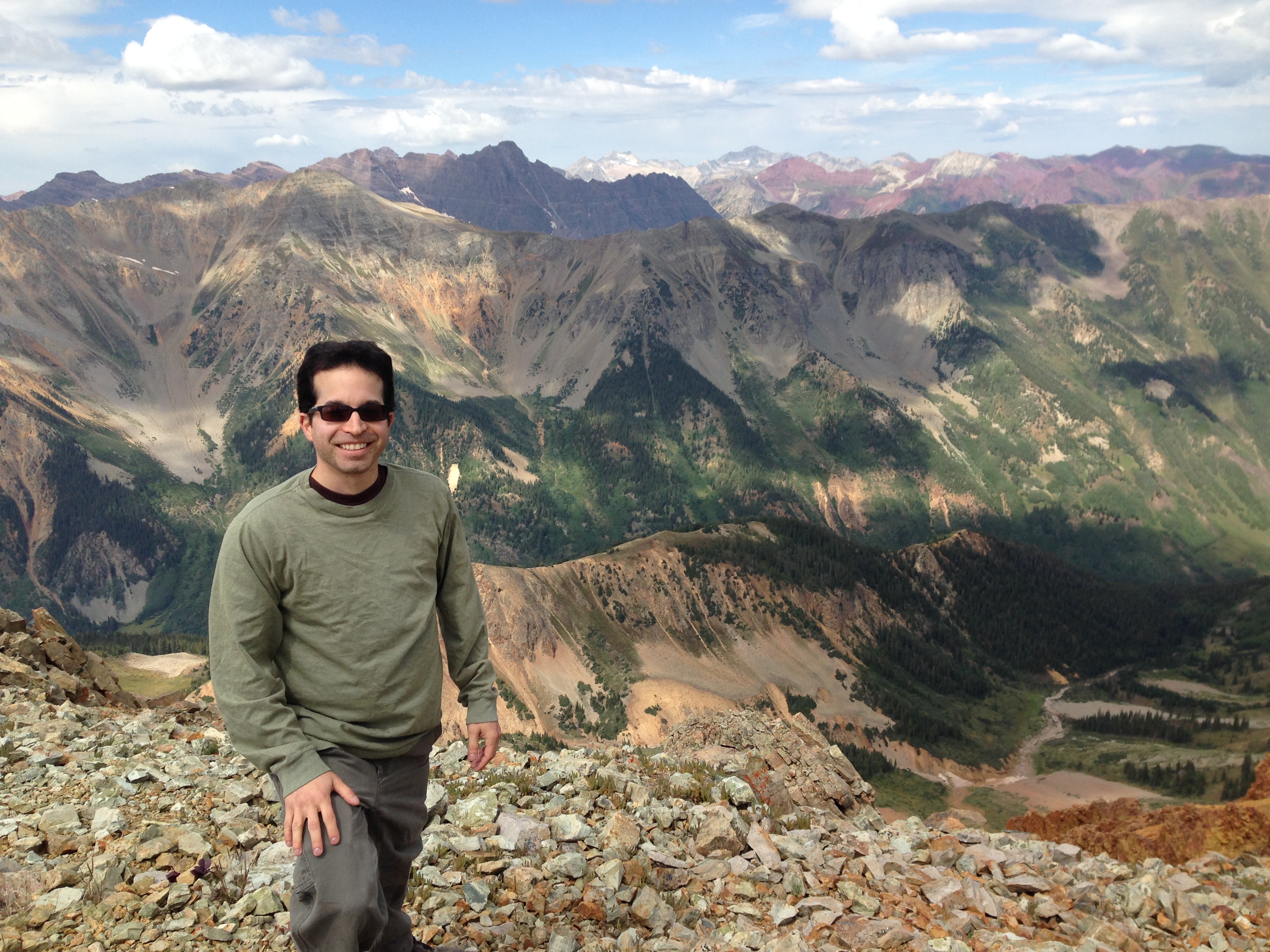
Since I grew up in Colorado, I have to add that Aspen is fine and I understand why it’s popular, but there are many beautiful mountain towns in the Colorado Rockies. Visitors and businesses should spread the love to other places too, like Glenwood Springs, Durango, Leadville, Estes Park, etc… In any case, when we had time off, it was fun to go hiking and biking in the area. For example, I took the following photo after hiking to the top of Electric Peak (elev. 13635 ft., 4155 m), and lower down I’ve included photos of Lost Man Lake (near the continental divide) and the iconic Maroon Bells.

photo 11

The Aspen Center for Physics (ACP) is a great place for working and collaborating with colleagues. As they say on their website, “Set in a friendly, small town of inspiring landscapes, the Center is conducive to deep thinking with few distractions, rules or demands.” As usual, we had a very flexible schedule that allowed for plenty of conversations and discussions outdoors or in our temporary offices. Weather permitting, we had lunch and some meetings outside, and we had many social events too, including lemonade and cookies on Mondays and weekly barbecues. It’s also family-friendly, and many physicists brought their spouses and kids to Aspen too. I’ve attended one ACP summer workshop on a similar theme (“Modeling Galaxy Clustering”) in June 2007, and it too was both fun and productive. Note that the ACP workshop is very different than the Madrid workshop I attended earlier this summer, which had specific goals we were working toward (and I’ll give an update about it later).

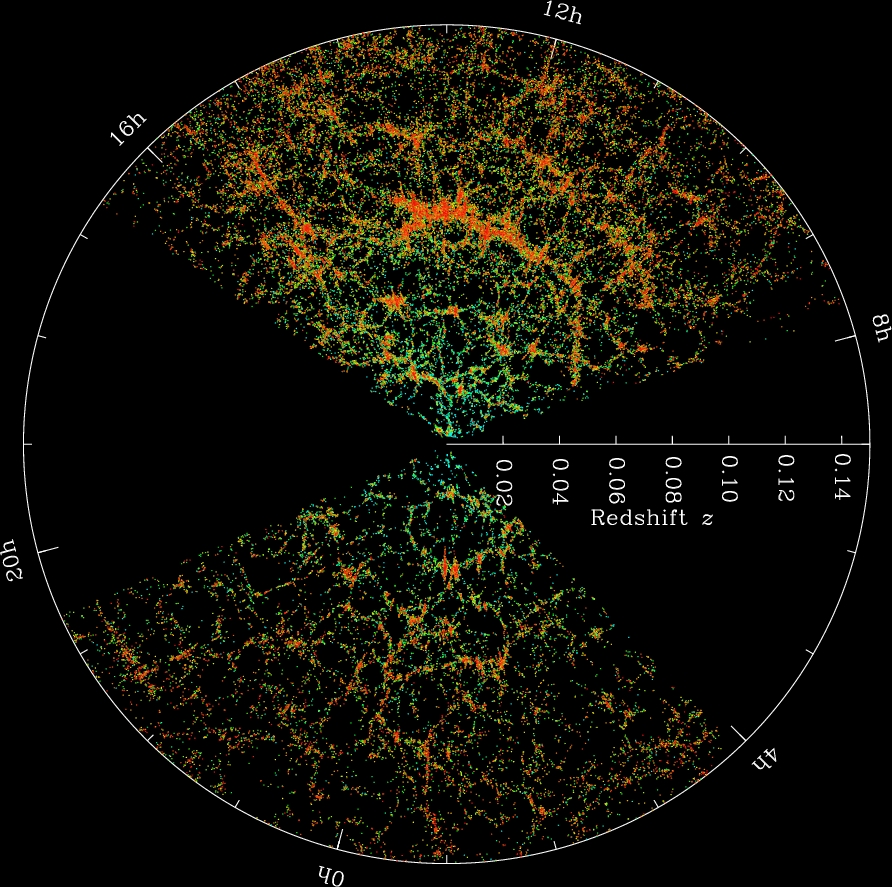
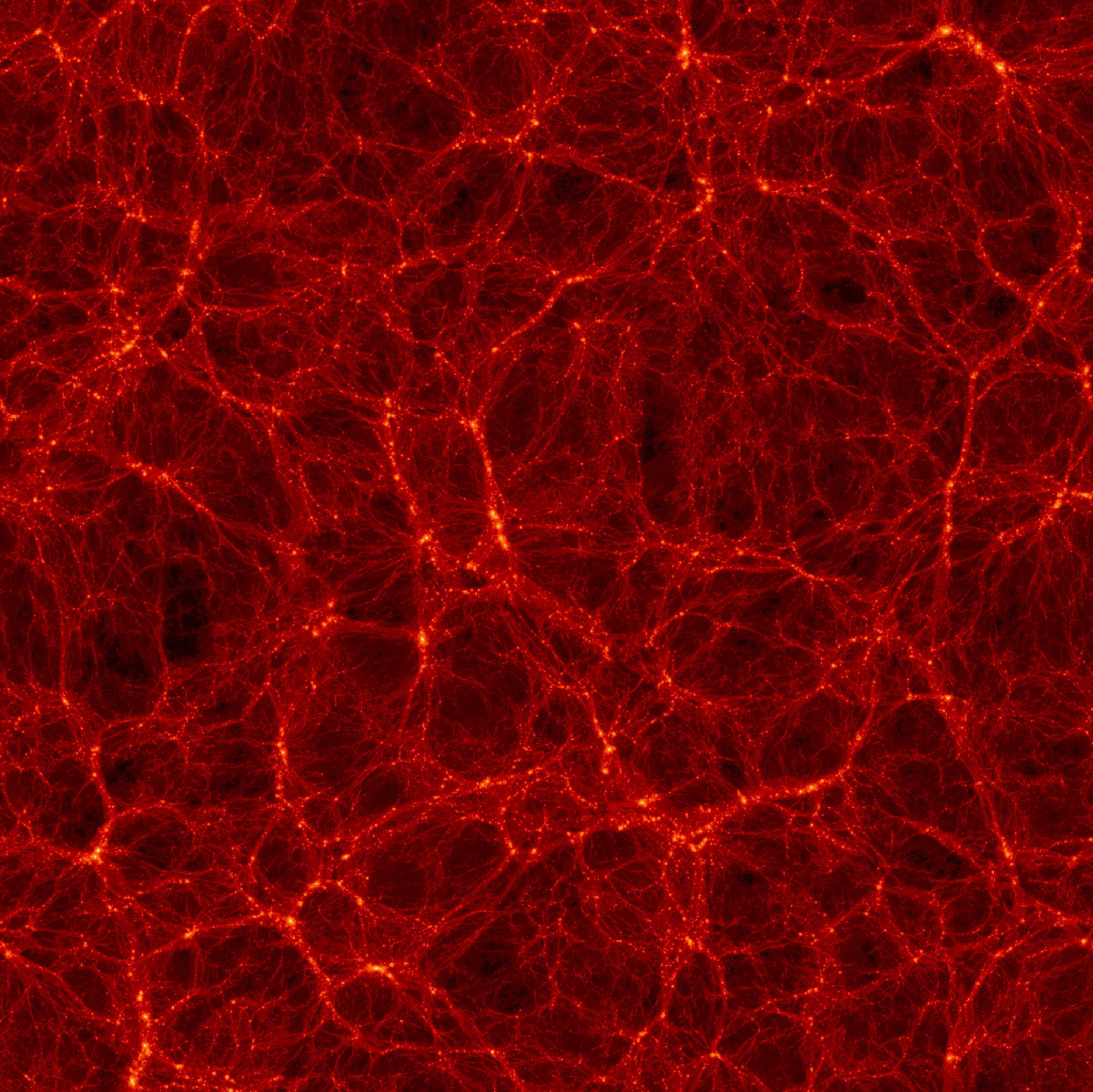
This year’s Aspen workshop connected important research on the large-scale structure of the universe, the physics of dark matter halo assembly, the formation and evolution of galaxies, and cosmology. We had informal discussions about the masses and boundaries of dark matter haloes in simulations, ways to quantify the abundances and statistics of galaxies we observe with telescopes and surveys, and how to construct improved models that accurately associate particular classes of galaxies with particular regions of the “cosmic web”—see this Bolshoi simulation image, for example, and the following slice from a galaxy catalog of the Sloan Digital Sky Survey:

rcolor_main_all_z0

While some of these issues have plagued us for years and remain unresolved, there are some subtle issues that have cropped up more recently. We (including me) have successfully modeled the spatial distribution of galaxies in the “local” universe, but now we are trying to distinguish between seemingly inconsistent but similarly successful models. For example, we know that the distribution of dark matter haloes in numerical simulations depends on the mass of the haloes—bigger and more massive systems tend to form in denser environments—as well as on their assembly history (such as their formation time), but these correlations can be quantified in different ways and it’s not clear whether there is a preferred way to associate galaxies with haloes as a function of these properties. For the galaxies themselves, we want to understand why some of them have particular brightnesses, colors, masses, gas contents, star formation rates, and structures and whether they can be explained with particular kinds of dark matter halo models.

IMG_1862

The main purpose of these workshops is to facilitate collaborations and inspire new ideas about (astro)physical issues, and it looks like we accomplished that. The previous workshop I attended helped me to finish a paper on analyzing the observed spatial distribution of red and blue galaxies with dark matter halo models (arXiv:0805.0310), and I’m sure that my current projects are already benefiting from this summer’s workshop. We seem to be gradually learning more about the relations between galaxy formation and dark matter, and my colleagues and I will have new questions to ask the next time we return to the Rockies.

Finally, here are those Maroon Bells you’ve been waiting for:

IMG_1849

Nuclear (non)proliferation and the Security of Earth

We all want global security, since at least for now, the Earth is the only planet we’ve got. In the words of The Tick (in the 1990s cartoon), “You can’t blow up the world…That’s where I keep all my stuff!”

MV5BMTU1OTc0MDA3OV5BMl5BanBnXkFtZTcwMzI4NTQzMQ@@._V1._CR0.883331298828125,1.5333404541015625,351,459_SY317_CR14,0,214,317_AL_

In my previous post, I ended by raising the issue of the political scientist James Doyle, who was apparently fired from the Department of Energy’s (DOE’s) Los Alamos National Laboratory (LANL) in New Mexico after publishing a scholarly article questioning US nuclear weapons doctrine and defending President Obama’s goal of a nuclear weapons-free future. James Doyle’s article was titled “Why Eliminate Nuclear Weapons?,” and I’ll give you an extended quote from its conclusions, as it’s written rather well:

The marginal contribution that nuclear deterrence now makes to the absence of major aggression between great powers is being purchased at too high a price. That price is the constant risk that a complex, tightly coupled and largely automated system subject to normal, systemic and human error will, as science tells us, inevitably fail, and fail catastrophically, with unprecedented and unjustified loss of civilian life…Nuclear weapons are useless for confronting and resolving the most likely future international security challenges, but steady progress towards the elimination of such weapons can help nations confront these transnational problems…[E]limination of nuclear weapons will allow creative, intellectual, technical and financial resources now devoted to nuclear threats to be focused toward the resolution of transnational crises faced by all nations. As nuclear weapons are drawn down those resources can be re-focused toward developing clean energy, carbon-capture technologies, clean water management and low-impact, high-productivity agriculture.

The Federation of American Scientists (FAS) is calling on Energy Secretary Ernest Moniz to get involved in the case. According to Science journal, the lab recently made the following statement: “James Doyle’s separation from Los Alamos National Laboratory was a layoff due to the lack of available or anticipated funding in his area of expertise. The separation was unrelated to his publications or professional writings.” Many external arms control specialists are skeptical and believe Doyle’s downfall is the result of his airing of views that are unpopular among those opposing disarmament, including some of the Armed Services Committee’s Republican leaders and staff. And if you’re curious about how many resources LANL spends on weapons activity versus nonproliferation, take a look at the following graph (reported by the Center for Public Integrity).

chart

Although nuclear weapons (and “mutually assured destruction”) seem like a Cold War issue and a thing of the past, they’re as relevant as ever today. In and near the Middle East, where Israel, Pakistan, and India have nuclear weapons, proliferation is a real concern. In addition, according to Newsweek, countries in Russia’s neighborhood are now considering nuclear deterrence. Altogether, the US possesses 2,104 (active) nuclear warheads, Russia has a similar number, and numerous other countries have hundreds either mounted on planes or on submarines. Germany will not continue its nuclear-hosting duties beyond the 2020s, and a Central European official was recently quoted as saying, “If the Germans don’t want [the bombs], we’ll take them.”

According to Scientific American, the FAS begin with the “scientists’ movement” in the mid-1940s when many scientists who had worked on the Manhattan Project recognized that they had a special responsibility to educate policymakers and the public about the implications of nuclear energy and nuclear weapons. (Carl Sagan, who is one of my heroes, had served on FAS’s advisory council and was a leading scientist devoted to reversing the nuclear arms race.) The FAS’s Nuclear Weapons Database is one of the most reliable sources on global nuclear arsenals, and the numbers in the previous paragraph were obtained from it. As far as we know, the US is not developing new nuclear weapons, but unfortunately it’s improving the weapon delivery systems (see this report from the Union of Concerned Scientists). This does not aid the goals of nonproliferation and reducing nuclear weapons, nor does the US’s nearly 500 land-based missiles on “hair-trigger” alert.

As I’ve mentioned in a previous post, nuclear weapons are also relevant to space security and to the risk of a space arms race. Although deploying nuclear weapons in space may be prohibitively expensive and are a violation of the Outer Space Treaty, certain nuclear missiles could have trajectories outside of the Earth’s atmosphere, and anti-satellite missiles are another concern. In any case, space weapons—nuclear or otherwise—increase tensions between countries and increase the risk of conflict.

Another related issue is the Nuclear Nonproliferation Treaty (which, by the way, has never been signed by India, Israel, and Pakistan). In the 21st century era of worsening climate change, we need alternatives to fossil fuel-based energy, but nuclear energy surely is not ideal. It’s not clear how much, if it all, nuclear energy should play a role in our transition to a fossil fuel-free economy. Even in Iran, where there is an apparent abundance of oil, people are trying to prepare for the transition, and as in other places, they have turned to nuclear energy. An additional concern is that developing nuclear energy technologies produces a pathway for countries to develop nuclear weaponry as well; unfortunately, we’ve seen other countries follow this path already. In the case of Iran, as usual, what is required is a diplomatic and political settlement. As argued in a report by the FAS and the Carnegie Endowment for International Peace, by offering Iran cutting-edge alternative energy technologies, especially to take advantage of the country’s solar energy potential, a positive precedent could be set for other nuclear-hopefuls.

Journalism and Science Groups Criticize EPA’s Policy Muzzling Science Advisers

As reported by the Associated Press and The Hill, a coalition of journalism and science groups are criticizing the US Environmental Protection Agency (EPA) to end a policy of restricting independent science advisers from contacting and communicating with media outlets, Congress, and others, without permission. The organizations include the Union of Concerned Scientists (UCS), Society of Environmental Journalists (SEJ), American Geophysical Union, Society of Professional Journalists, Society for Conservation Biology, Investigative Reporters and Editors, and Reporters Committee for Freedom of the Press. (Full disclosure: I am a UCS member and obtained some of my information from them.)

epa_logo

In a letter sent to the agency last week, they said that the new policy

requir[es] advisory committee members who receive requests from the public and the press ‘to refrain from responding in an individual capacity’ regarding issues before the committee. The policy requires all requests…to be routed through EPA officials. This prevents many of our nations top independent environmental science experts from sharing their expertise, unfiltered, with the public…The new policy undermines EPA’s efforts to increase transparency. It also contradicts the EPA’s new scientific integrity policy…[It] only reinforces any perception that the agency prioritizes message control over the ability of scientists who advise the agency to share their expertise with the public. On July 8, 38 journalism and good government organizations wrote the president expressing concern about ‘the stifling of free expression’ across many agencies, including the EPA.

The language of the policy is sufficiently vague that it would be easy for a scientist to interpret it such that she or he can’t speak publicly about any scientific issue under consideration. In addition, as pointed out by Andrew Rosenberg, scientists who work for the EPA also face barrier in communicating with the public.

What are the implications of this and why is it important? As the letter points out, this is clearly related to the issue of scientific integrity. We need scientists to serve on advisory committees, work with agencies and policy-makers, and speak transparently about their work and expertise, but such policies will discourage some from participating and will make the EPA less democratic. Government agencies, journalists, and the public deserve access to independent advice and free speech of scientists. (However, we scientists should be careful about speaking about issues beyond our expertise.) That way agencies can make informed decisions when developing or reforming relevant policies and regulations, and journalists and the public can form their own opinions about them as well.

In an update on the situation, the EPA Chief of Staff Gwendolyn Keyes-Fleming responded to say that their Science Advisor, Dr. Bob Kavlock, would review the matter and engage with people in the organizations involved. Let’s hope that the dialogue results in changing the policy.

600px-US-DeptOfEnergy-Seal.svg

Finally, in recent related news, political scientist James Doyle says that he was fired from the Department of Energy’s (DOE’s) Los Alamos National Laboratory (LANL) in New Mexico after publishing a scholarly article questioning US nuclear weapons doctrine. They claimed that the article, criticizing the political theories behind the nuclear arms race and a defense of President Obama’s embrace of a nuclear weapons-free future, contained classified information. (We should note though that unfortunately the DOE’s policy on scientific integrity is much shorter and may be more restrictive than the EPA’s.) I’ll keep you updated on this situation, and time permitting, I may write about it further in another post.

Rosetta and the Comet

The title sounds like I’ll tell you a fable or short story or something. This is neither of those things, but it is quite a story! I’m not personally involved in the Rosetta mission, though I’ll do my best to tell you about it and what’s unique and exciting about this. (For you fellow astrophysicists reading this, if I’ve missed or misstated anything, please let me know.) And if you’d like more information and updates, I recommend looking at Emily Lakdawalla‘s blog posts on ESA and Phil Plait‘s blog on Slate. If you’re interested in the history and importance of comets (and about how “we’re made of starstuff”), check out Carl Sagan and Ann Druyan’s book, Comet.

Rosetta, the €1.3 billion flagship space probe (see below) of the European Space Agency (NASA’s European counterpart) has chosen to accept an ambitious mission: to chase down, intercept, and orbit a distant comet, and then send the lander Philae to “harpoon” itself to the surface and engage in a detailed analysis. Rosetta is obviously named after the Rosetta Stone in Egyptian history, and Philae is named after an island in the Nile. Rosetta and Philae are hip spacecraft: they even have their own Twitter accounts—@ESA_Rosetta and @Philae2014, respectively. They should be careful when examining the comet below its surface, because if it’s anything like Star Trek, they could find an ancient alien archive in the center! (Fans of the “Masks” episode will know what I’m talking about.)

Science Magazine

Comets are literally pretty cool. They’re clumps of ice, dust, and organic materials with tails that are hurtling through space. What is this comet Rosetta’s pursuing? It’s known as Comet 67P/Churyumov-Gerasimenko, named after a pair of Ukrainian astronomers who discovered it in 1969. 67P/C-G looks like a mere blob from a distance, but it’s 4km in diameter and lopsided with two barely-attached lobes that make it look like a rubber duck from certain angles. “It may be an object we call a contact binary which was created when two smaller comets merged after a low-velocity collision,” said mission scientist Matt Taylor, or it may have once been a spherical object that lost much of its volatile material after encounters with the sun. It also has plumes of dust and gas (from sublimated ices) erupting from the surface, which has a temperature of about -70 C. (The montage of images below are courtesy of ESA/Rosetta/NAVCAM/Emily Lakdawalla.)

20140806_NavCam_animation_6_August_selection_stack

rosetta_osiris_aug72014.jpg.CROP.original-original

Comets tell us about our past, since they’re thought to have formed in the cold of the outer solar system 4.6 billion years ago. They also yield information about the formation of the solar system and about the role of comets in delivering water and organic material to Earth in its history—possibly influencing the origin of life here. Cometary impacts are known to have been much more common in the early solar system than today. There may be billions of these dirty snowballs (or icy dustballs) orbiting the sun, and thousands of them have been observed. Prior to Rosetta, three comets have been analyzed by space probes: Halley’s comet by ESA’s Giotto in 1986, Comet Wild 2 by NASA’s Stardust in 2004, and Comet Tempel 1 by NASA’s Deep Impact, which slammed into it in 2005. The diagram below (courtesy of ESA/Science journal) shows the orbits of Rosetta and 67P/C-G. The comet has been traveling at speeds up to 135,000 km/hr, and Rosetta had to use flybys of the Earth and Mars to maneuver onto the same orbital path. Rosetta will be the first mission ever to orbit and land on a comet, so this is really an historic moment in space exploration.

F4.large

On 11 November, Rosetta will be in a position to eject the Philae lander from only a couple kilometers away. Philae is 100 kg, box shaped with three legs and numerous instruments for experiments (see below), and was provided by the German Aerospace Research Institute (DLR). NASA scientists talk of the “7 minutes of terror” as the Curiosity rover descended to Mars, but Philae’s descent will take hours. Note that 67P is so small and gravity is so weak that the lander would likely bounce off, which is why it needs the harpoons as well as screws on the legs to bolt it to the surface. If the landing is successful—let’s cross our fingers that it is—it will perform many interesting experiments with its instruments. For example, CONSERT will use radio waves to construct a 3D model of the nucleus, Ptolemy will measure the abundance of water and heavy water, and COSAC will look for long-chain organic molecules and amino acids. COSAC will also detect the chirality of the molecules and maybe determine whether amino acids are always left-handed like the ones on Earth. (“Chirality” means “handedness”. I think the only other time I heard the term was for the spin statistics of spiral galaxies.)

Philae_s_instruments_black_background_node_full_image_2

Let’s hope for Rosetta’s and Philae’s success! I’ll update you on this blog when I hear more information.

Exploring the “Multiverse” and the Origin of Life

After two weeks away from the blog, I’m back! At the end of July, I attended an interesting event at UC San Diego’s Arthur C. Clarke Center for Human Imagination. (Yes, that’s what it’s called!) The event was a panel discussion entitled, “How Big is the World?: Exploring the Multiverse in Modern Astrophysics, Cosmology, and Beyond” (and you can watch the event here). The three speakers included Andrew Friedman (postdoctoral fellow in astronomy at MIT), Brian Keating (professor of physics in my department at UCSD), and David Brin (Hugo & Nebula Award Winning Author).

The Clarke Center seems to be a unique place with an ambitious program that incorporates a variety of “transdisciplinary” activities. This event fits with their nebulous theme, and the talks and discussions frequently overlapped between science, philosophy of science, and science fiction. I think science and philosophy of science go well together especially when we’re exploring the edges of scientific knowledge, including cosmological astrophysics and the origins of human life. (See my previous post and this recent article on Salon.) Too often astrophysicists, myself included, become very specialized and neglect the “big questions.” Nonetheless, I think we should be careful when we traverse the border between science and science fiction: while it’s exciting to connect them and useful for public outreach, we should mind the gap.

Andrew Friedman focused on the “multiverse”. What is a multiverse, you ask? I’m not entirely clear on it myself, but I’ll try to explain. In the first fraction of a second of the Big Bag, the universe appears to have gone through a phase of accelerated, exponential expansion (called “inflation”) driven by the vacuum energy of one or more quantum fields. The gravitational waves that were recently detected by BICEP2 (in which Brian Keating was involved) appear to support particular inflationary models in which once inflation starts, the process happens repeatedly and in multiple ways. In other words, there may be not one but many universes, including parallel universes—a popular topic in science fiction.

multiverse-magazine-illustration-01_77755_990x742

Inflationary theory solves some problems involving the initial conditions of the Big Bang cosmology, but I’m not so sure that we have—or can ever have—evidence clearly pointing to the existence of multiverses. In addition, in my opinion, Friedman stretched the concept of “universe” to try to argue for the multiverse. He spoke about the fact that there are parts of the universe that are completely inaccessible even if we could go the speed of light, but that doesn’t mean that the inaccessible regions are another universe. It’s fun to think about a “quantum divergence of worlds,” as David Brin referred to it, but quantum mechanics (with the standard Copenhagen interpretation; see this book by Notre Dame professor Jim Cushing) don’t imply a multiverse either: Schrödinger’s live cat and dead cat are not in separate universes. As far as I know, I’m not creating new universes every time I barely miss or catch the train.

The speakers did bring up some interesting questions though about the “anthropic principle” and “fine tuning.” The anthropic principle is a contentious topic that has attracted wide interest and criticism, and if you’re interested, read this review of the literature by Pittsburgh professor John Earman. The anthropic principle is the idea that the physical universe we observe must be compatible with conscious life. It’s a cosmic coincidence that the density of vacuum energy and matter are nearly equal and that the universe’s expansion rate is nearly equal to the critical rate which separates eternal expansion from recontraction, and if the universe were significantly different, it would be impossible to develop conscious life such as humans who can contemplate their own universe. (In the context of the multiverse, there may be numerous universes but only a tiny fraction of them could support life.) It’s important to study the various coincidences and (im)probabilities in physics and cosmology in our universe, but it’s not clear what these considerations explain.

David Brin spoke differently than the others, since he’s more a writer than a scientist, and his part of the discussion was always interesting. He frequently made interesting connections to fiction (such as a legitimate criticism of Walt Whitman’s “Learn’d Astronomer“) and he had a poetic way of speaking; when talking about the possibility of life beyond Earth, he said “If there are living creatures on Titan, they will be made of wax.” He also brought up the “Drake equation,” which is relevant in the context of the topics above. The Drake equation is a probabilistic expression for estimating the number of active, communicating civilizations in our galaxy. It involves a multiplication of many highly uncertain quantities (see this xkcd comic), but it’s nonetheless interesting to think about. The problem is that space is really big—”vastly, hugely, mindbogglingly big,” according to Douglas Adams—so even if there are Vulcans or Klingons or dozens or millions of other civilizations out there, it would take a really really really long time to find them and attempt to communicate with them. We could send people from Earth in a long shuttle ride to visit another civilization, but there’s no guarantee that humanity will still be around when they try to call back. It’s unfortunate, but this is the universe we live in.