The climate crisis is not a reproductive crisis

If you read or listened to NPR’s All Things Considered last week, then you probably came across this interesting article and podcast by Jennifer Ludden, provocatively titled, “Should We Be Having Kids In The Age of Climate Change?” This post is mostly in response to that, and I suggest checking out the NPR piece before reading this.

Ludden and Travis Rieder, a philosopher and ethicist at Johns Hopkins University whom she highlights, help to provoke discussion, and I appreciate that. They make a pretty compelling argument, while raising questions people rarely consider or talk about. But as you’ve probably guessed, I’m not convinced by the argument. Nonetheless, after suffering through July, the warmest month ever recorded, this is a good time to discuss these issues.

Map of temperature rises that have *already* occurred. (Credit: US National Climate Assessment / NASA)

Map of temperature rises that have *already* occurred. (Credit: US National Climate Assessment / NASA)

Rieder argues that the simplest solution to address climate change and reduce carbon dioxide emissions is to have fewer children. The emissions savings one can make during a lifetime don’t add up to the projected emissions of a whole other person, he says. I agree with many points he makes, but it’s not so simple.

Climate scientists project average global temperatures to rise by more than 2 degrees Celsius, a pivotal level that could take us past some “tipping points,” and the Paris climate agreement falls far short of preventing that.

We need to take dramatic action. Just making a few adjustments here and there isn’t going to cut it. Not even close. Prius-driving people with Al Gore-approved light bulbs at home aren’t saving the world—far from it.

Continue reading

Campaign promises and proclamations I hope President Hillary Clinton will fulfill

I know, it’s probably premature to talk about what President (Hillary) Clinton could or should do. Poll aggregates currently estimate about an 88% chance of her winning the election, but you don’t need to be a political scientist to know that that’s far from guaranteed. A lot can happen in the next two and a half months, and we haven’t seen Clinton and Donald Trump debate yet. But barring a major shift, Clinton will likely prevail in November.

(Credit: U.S. Department of State)

(Credit: U.S. Department of State)

If she wins handily, by a margin of even 10%, and if there’s a big turnout of the electorate (60% turnout is actually considered high in this country), then Clinton can say that she’s earned a “mandate.” But as the New York Times asked on Monday, what exactly will that mandate be for? Thomas Frank argues in the Guardian that, as Trump’s campaign nosedives, Clinton need only campaign against him, rather than for a progressive agenda. What Clinton says in her speeches and whom she highlights as her top advisors and endorsers is at least as good a sign of what’s to come as her official platform.

In any case, many voters as well as observers abroad pay close attention to her policy positions and campaign promises, and they want action, not just rhetoric. As noted by the LA Times and the Atlantic, political-science research shows that promises made during this phase of the campaign often get followed up on later (with mixed results). Here are a few in particular I’m hoping she follows through on. Clinton will be able to make progress on many of these even if the Congress becomes gridlocked.

Continue reading

News from Nature: women in physics, atom wranglers, musical preferences

Here’s some fascinating stories I’ve been working on lately for Nature in Washington, D.C. I’m proud of these first three news stories for them, and if you’re interested, check them out on Nature‘s website. (And if you quote or cite any of them, please give proper credit.) Special thanks go to my editors, Lauren Morello and Jane Lee.


Women in physics face big hurdles — still

Persistent biases continue to affect the numbers of female physicists.

There are more women in the sciences than ever before. They hold leading faculty and administrative positions while their representation in fields such as biology, sociology and psychology has increased. Yet the physical sciences are woefully behind when it comes to the number of women at all levels.

“Physics and engineering both have big gender divides,” says Eric Brewe, a physics education researcher at Florida International University in Miami.

This persistent problem prompted a special issue of the journal Physical Review Physics Education Research, with 17 papers and an editorial on gender issues in physics, published on 1 August. Brewe was one of two guest editors for the issue.

(Credit: ullstein bild/Getty)

(Credit: ullstein bild/Getty)

…The special issue addresses the reasons why relatively few women enter the field of physics, as well as the factors that deter them from completing their degrees. They include a lack of role models, entrenched stereotypes and an undervaluing of their abilities. Many authors also highlighted the fact that women are — usually inadvertently — made to feel like they don’t fit in…

[For more, read the entire story in Nature, published on 1 August 2016.]

Continue reading

Random thoughts from a new father/science writer

My partner and I recently had a baby, whom we of course named after a 9th century Persian scientist and writer. For a creature so tiny, our baby has surely delivered huge changes to our lives. I was out on paternal leave for the month of June (the only month this blog has gone post-less since 2013), and I’ve had much to observe and think about over those sleep-deprived days and nights. Here are a few samples, assembled in no particular order.

1. Having a baby changes the way I view many things. Events and activities in the baby’s life naturally take on great importance for me. At the same time, I feel like I’m often trying to take the long view of things and think of the big picture, and I’m careful not to take the baby or my partner for granted. I stoically face many day-to-day concerns that used to bother me in the past. Well maybe not so stoically—taking care of a baby is even more challenging than I expected—but I do think my tolerance for stress and lack of sleep has gone up.

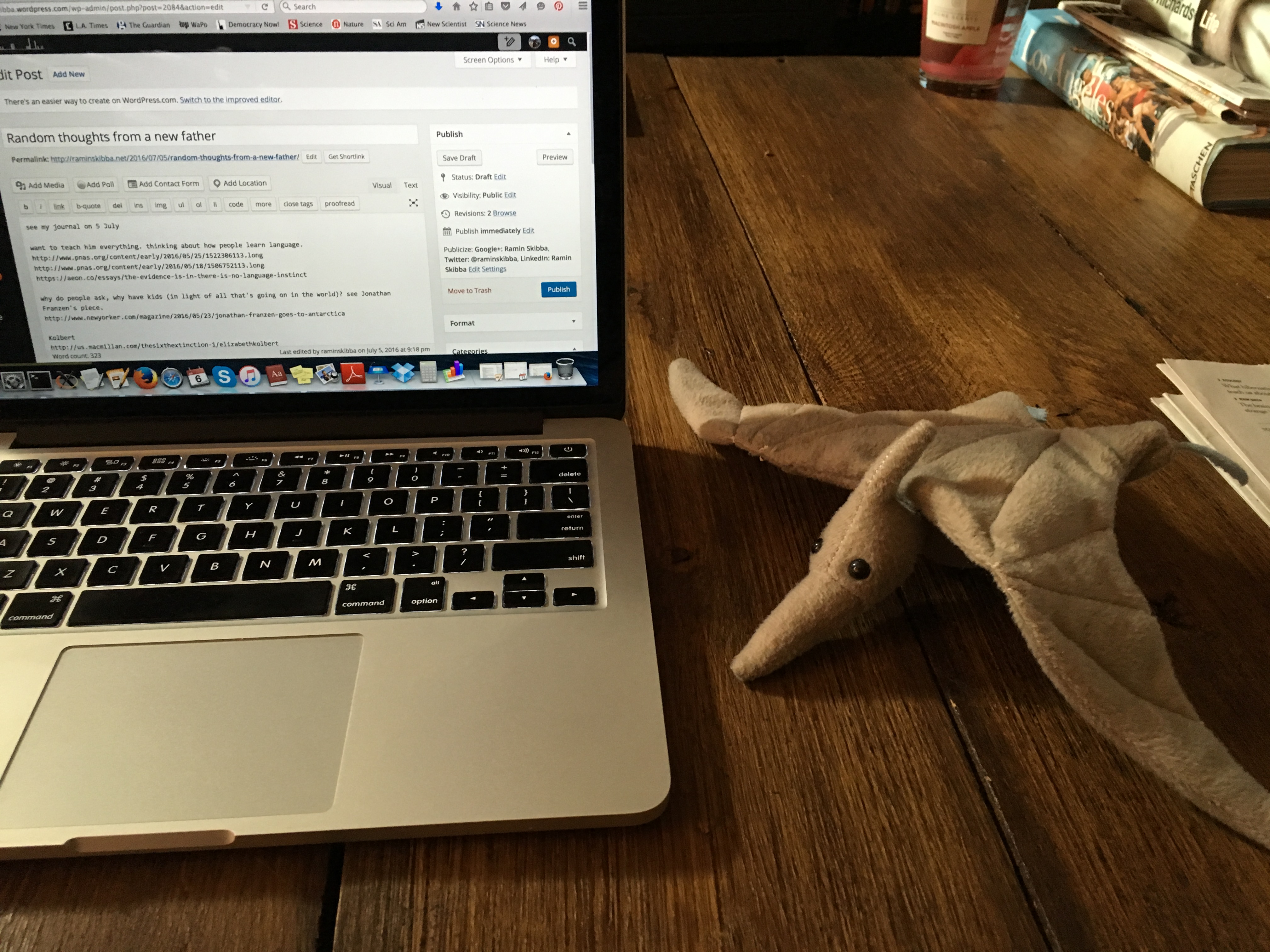
Here's my baby's stuffed pterodactyl, reminding me to stay focused on the important things.

Here’s my baby’s stuffed pterodactyl, reminding me to stay focused on the important things.

2. It’s been an interesting experience bonding with my baby. He magically/biologically appeared in my life with me really having no relationship with him at the time. But over the past six weeks, as he has grown rapidly, our relationship has bloomed, and I can’t describe how much I love him. I love his frog-like hiccuping, his well-timed side-eye, and the way he furrows his brow just like his mother.

3. As I read about science news and scientific discoveries for my work, I can’t help but view them through the lens of a parent. A study about the vocal learning of songbirds makes me wonder how I’ll teach my son multiple languages. (See also this essay in Aeon. How children learn language is actually a fascinating and poorly understood subject.) The recent finding that one third of humanity cannot see the Milky Way because of light pollution makes me wonder how my child will view the night sky. In my opinion, how we see the sky affects how we view our lives on Earth. (By the way, the National Park Service, now celebrating its centennial, has an amazing photo gallery.)

An excellently framed night sky view of the Milky Way at Dinosaur National Monument, Utah. (Credit: NPS / Dan Duriscoe)

An excellently framed night sky view of the Milky Way at Dinosaur National Monument, Utah. (Credit: NPS / Dan Duriscoe)

4. Gender stereotypes and pressures on mothers persist, as people tend to view new mothers juggling work and a kid as “distracted” while new fathers balancing work and life are viewed as “responsible.” (See this recent sociological study, for example.) We definitely have a long way to go to achieve gender equality. And I still have much to learn about balancing all these responsibilities.

5. Some people ask, why would you have a kid in today’s dangerously warming and overpopulated world? I read the following in a piece by Jonathan Franzen in the New Yorker last month: “It’s true that the most effective single action that most human beings can take not only to combat climate change but to preserve a world of biodiversity, is to not have children.”

No, that’s not true. This doesn’t make sense to me, as these may be tough times but we’re not living in some post-apocalyptic dystopia. Our planet more easily supports five billion humans than eight billion, but the latter is not impossible. And in general, each woman and couple has to answer for themselves the complicated question about whether or not to have a kid.

To be sure, a new human being may turn out to be not much more than yet another producer of greenhouse gas emissions. Or they may become a force for good and part of the solution. Furthermore, as I’ve written before, it’s a mistake to overemphasize the problem of overpopulation, which puts the burden on the poor; excessive consumption per capita is a much bigger problem.

6. Coincidentally, I finished reading Elizabeth Kolbert’s The Sixth Extinction during our baby’s first month. (Yes, I realize it’s weird reading about mass extinctions while simultaneously creating life!)

9781250062185

Here’s a controversial quote toward the end of her book: “What matters is that people change the world…This capacity is probably indistinguishable from the qualities that made us human to begin with: our restlessness, our creativity, our ability to cooperate to solve problems and complete complicated tasks. As soon as humans started using signs and symbols to represent the natural world, they pushed beyond the limits of that world…Were people simply heedless or selfish or violent, there wouldn’t be an Institute for Conservation Research, and there wouldn’t be a need for one. If you want to think about why humans are so dangerous to other species, you can picture a poacher in Africa carrying an AK-47 or a logger in the Amazon gripping an ax, or, better still, you can picture yourself, holding a book on your lap.”

In my opinion, Kolbert, too, is mistaken about the role of humans in the world. Humans do have a tendency to spread, sometimes unwittingly or purposefully destroying things in their path. But that doesn’t have to be the case, and we need not be so critical or cynical about humanity. She seems to think that humanity’s dominant and unchangeable qualities are selfishness, destructiveness, and shortsightedness. Yes, humans have contributed to the extinction of countless species, but that’s a trend that need not continue indefinitely. (She also mentions climate change and suggests that the only positive way we might address it is with farfetched geoengineering schemes, but that’s not true either.) Moreover, if we try to find a way to look with hope to the future, we, along with our offspring, will work harder to change it for the better.

Inside Science reviews: “The Big Picture” (Sean Carroll’s book) and “The Man Who Knew Infinity”

Here are excerpts from a new book review and movie review I’ve written recently for Inside Science News Service. I have a few additional thoughts about Sean Carroll’s book, below this excerpt.


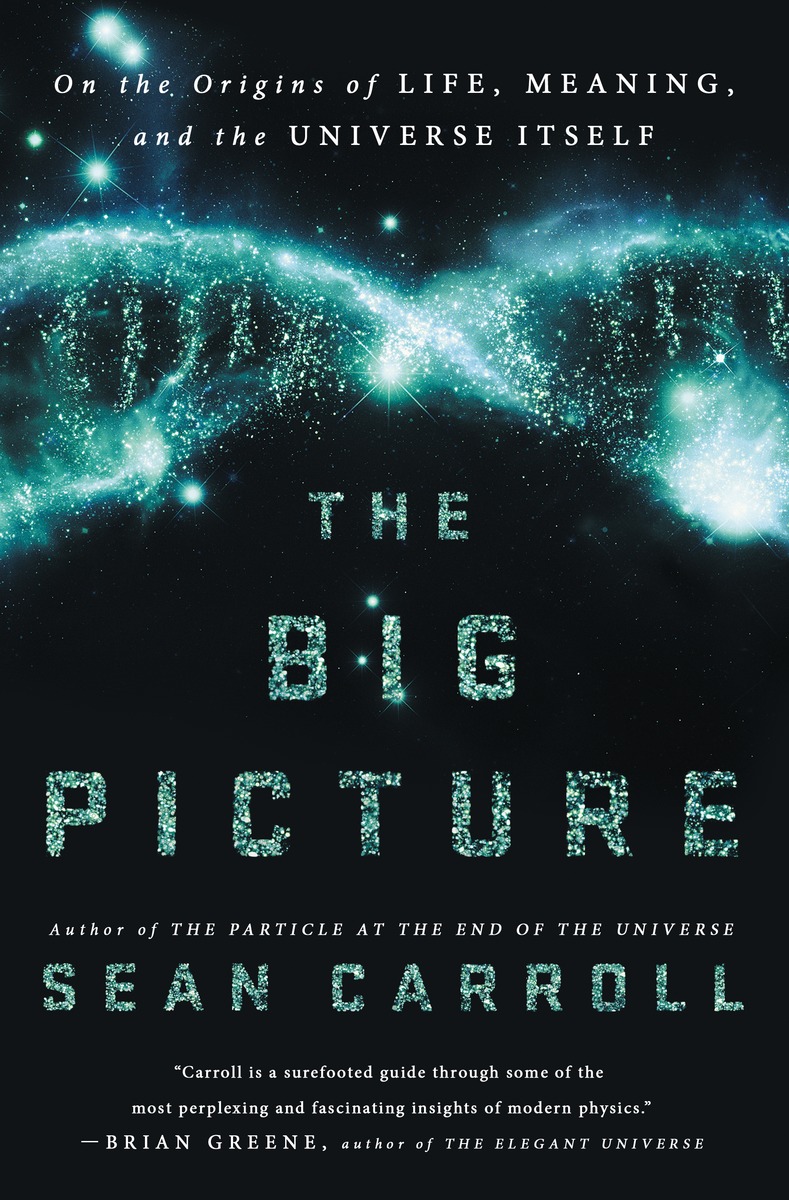
Sean Carroll’s ‘Big Picture’ Tours Physics And Philosophy

In a new book, Sean Carroll brings together physics and philosophy while advocating for “poetic naturalism.”

Quantum physics, cosmology, existentialist philosophy and morality may seem like disparate subjects. But Sean Carroll, a theoretical physicist at Caltech, ties them all together into a cohesive and comprehensive worldview he calls “poetic naturalism.” He lays out his views while trying to find meaning in a vast and chaotic universe in his newly published book, “The Big Picture” (Dutton, Penguin Random House Inc.).

Having written two previous popular physics books as well as being active on Twitter and his blog, Carroll takes an interest in communicating complex scientific discoveries. In his new book, he describes some of the fundamental ideas in modern physics with a philosophical lens, while exploring life’s biggest mysteries: the origin of the universe and the meaning of life itself. At the same time, with references to Wile E. Coyote, Captain Kirk and “Bill and Ted’s Excellent Adventure,” he avoids an overly serious tone.

In recent years, prominent scientists like Neil deGrasse Tyson, Bill Nye and Stephen Hawking have downplayed the importance of philosophy or even denigrated it. Carroll is not among this crowd.

“There are a lot of scientists and science promoters who have said not entirely complimentary things about philosophy, but that misses the point about what it’s for,” Carroll said in an interview. “The purpose of philosophy is not to be the handmaiden of science.”

(Credit: Dutton, Penguin Random House, Inc.)

(Credit: Dutton, Penguin Random House, Inc.)

Though his Ph.D. is in physics, Carroll has a strong interest in philosophy as well, and minored in it in college. He sees philosophy as a method for interpreting science and for a deeper understanding of physical phenomena. He uses philosophical concepts such as causality, determinism and mind-body dualism to explore everything from the tiniest subatomic particles to the accelerating expansion of the universe — as well as the role humans play somewhere in between.

For Carroll, naturalism means that there’s one world, the natural world, it obeys the laws of nature, and you can discover it using science. To this he adds that “there are many ways of talking about the world,” stories that people can tell to make sense and meaning of the world and their place in it. He even address issues of free will, consciousness, ethics, and life after death…

…The situation becomes murkier when Carroll discusses quantum mechanics, the interpretation of which has continually generated debates among physicists and philosophers since Max Planck and Albert Einstein discovered light “quanta” in the early 20th century. Physicists interpret quantum systems with probabilities: for example, for a hydrogen atom, the electron doesn’t have a particular position or momentum, but if someone measures them, it has probabilities of being observed in particular states.

Carroll supports the controversial “many-worlds interpretation” in which every quantum possibility is literally a separate world (or universe). We happen to live in one of them, and we have no way of seeing or even confirming the existence of the many unobservable parallel universes. This interpretation seems to conflict with his claim of endorsing a “sparse ontology,” which would mean accepting only a few fundamental concepts for describing the natural world.

“What I took Carroll to be promoting was a kind of ‘verificationism’: what is true is what can be measured,” said Elise Crull, philosopher of science at the City College of New York. “But what counts as ‘measurable,’ and how we distinguish theoretical from observational statements, are complex issues.” This is why, she argues, philosophers considered the view problematic and abandoned it long ago…

[For more, check out the entire story in Inside Science, published on 19 May 2016. Thanks to Chris Gorski and Emily DeMarco for editing assistance.]

Additional thoughts:
I think Carroll’s book does a great job of tying together so many disparate concepts, and I commend his efforts to communicate philosophical ideas. It’s important to encourage people to think and talk about “what it all means.” However, I think Carroll comes across as a little overconfident sometimes, as if he has all the answers. (But he’s more modest at other times.) Furthermore, he’s clearly more of an expert on the physics than the philosophy. His philosophical views don’t seem very nuanced or even self-consistent, and his book lacked a discussion of some important questions. (Exactly what are “laws” of nature and what do they tell us about how things actually behave? How do we assess the simplicity or predictive or explanatory power of a scientific theory?) He also missed some influential philosophers and physicists who have studied “scientific realism” in the context of cosmology and quantum physics for decades.

Continue reading

Inside Science: Dark Matter Particles, Cosmic Lenses, and Super-Earths

Here’s a few new stories I reported on and wrote for Inside Science News Service over the past couple weeks:


Physicists Look Beyond WIMPs For Dark Matter

Physicists are on the hunt for elusive dark matter, the hypothesized but as yet unidentified stuff that makes up a large majority of the matter in the universe. They had long favored “weakly interacting massive particles,” known as WIMPs, as the most likely dark matter candidate, but after an exhaustive search, some scientists are moving on to more exotic particles.

Most estimates suggest that there’s 5-6 times as much dark matter as there are things that we can see, such as galaxies, stars, and planets. Yet physicists know very little about what the mysterious dark matter particles actually are, as they cannot be directly observed and barely interact with normal matter.

New research leaves dwindling room for WIMPs, motivating a search for other particles that could fit the bill.

“The WIMPs are getting harsh experimental scrutiny, and may get ruled out,” said Kathryn Zurek, a physicist at Lawrence Berkeley National Laboratory in California. [Note: She later clarified that WIMPs may become more “strongly constrained” rather than “ruled out.”]

Physicists have used the Large Hadron Collider's ATLAS experiment to probe for potential dark matter particles. (Credit: CERN)

Physicists have used the Large Hadron Collider’s ATLAS experiment to probe for potential dark matter particles. (Credit: CERN)

Zurek and others presented ongoing work on dark matter alternatives to WIMPs in April at an American Physical Society meeting in Salt Lake City. “We should broaden the searchlight, and the natural place is to go lighter,” Zurek said.

She and her colleagues are looking into less massive particles that interact more weakly with ordinary matter. These include an array of particles with exotic names like “axion,” “sterile neutrino,” and “Higgsino,” a theoretical super-partner of the famous Higgs boson.

Axions are hypothetically abundant particles originally proposed in the 1970s to solve a problem with nuclear physics. In the presence of a powerful magnetic field, these minuscule particles, which are lighter than electrons, are predicted to turn into detectable photons. In spite of years of searching, however, they have yet to be found. But the Axion Dark Matter eXperiment, currently being upgraded, should definitely determine whether the particle exists, said Leslie Rosenberg of the University of Washington in Seattle.

Kevork Abazajian, a cosmologist at the University of California, Irvine, sees a new trend in the field over the past decade. “The new generation of early-career physicists is more open to dark matter other than WIMPs,” he said.

He argued that physicists should consider sterile neutrinos, which interact even more weakly than their neutrino counterparts. As they decay, the particles—which are tinier than electrons—could produce detectable X-ray radiation such as that observed in clusters of galaxies. But scientists struggle to distinguish between X-rays that could be emitted by sterile neutrinos versus traditional astrophysical events. Research along these lines suffered a setback when Japan’s powerful X-ray satellite Hitomi broke into pieces last month. But it may have accumulated limited science data before it was lost…

[For more, check out the entire story in Inside Science, published on 28 April 2016. Thanks to Chris Gorski and Sara Rennekamp for editing assistance.]

Continue reading

Space mining is becoming a reality. But is it legal?

After months of work, I just published an essay about mining asteroids for Nautilus! I’m happy to hear your thoughts on it and to try to answer any questions. I’ve already received many responses, and I believe I’ve helped spark a debate on the issues involved.

I left out some details about the legal and policy issues in the Nautilus piece, mainly about the convoluted path the U.S.’s Space Act took before it was passed and about tension between it and international law. If you’re interested in that, read on!

Illustration by Maciej Frolow / Getty Images

Illustration by Maciej Frolow / Getty Images

Just a few years old, space mining companies like the Google-backed Planetary Resources and the Silicon Valley-based Deep Space Industries already managed to accumulate plenty of clout in financial and political circles. But they lacked any national or international legal foundation: the companies formed before it was legal to mine asteroids.

The industries’ fascinating legal saga began in September 2014. Its allies in Congress put forth the American Space Technology for Exploring Resource Opportunities In Deep Space Act, also known simply as the ASTEROIDS Act. It received considerable debate and criticism in the House Science Committee, which killed the bill. But then it quickly reincarnated as the Space Act of 2015 and again reached the committee the following spring. This time, they allowed no oral statements. Joanne Gabrynowicz, professor emerita and space law expert at the University of Mississippi, who had previously identified flaws in the bill’s predecessor, could now only submit written testimony. In spite of her and others’ objections, the committee passed the bill within a single day, after which it faced no more significant obstacles.

“My impression is that the people who wanted it got the law out there quickly to placate investors,” Michael Listner, lawyer and founder of the Space Law and Policy Solutions think tank, told me.

The space mining industry finally received the endorsement it needed when a bipartisan majority of Congress passed the Space Act last fall. The U.S. Commercial Space Launch Competitiveness Act—its full title—would legalize the private mining of asteroids, for U.S. companies anyway. It would also encourage commercial spaceflight and tourism, but that seems to be a secondary focus. As expected, President Obama signed the bill into law just before the Thanksgiving holiday. Perhaps it was still considered far-fetched or obscure, or it was overshadowed by federal budget debates and early presidential campaigns, but in any case, the game-changing law was enacted with little fanfare in the media.

Gabrynowicz had pointed out a fundamental inconsistency between the unprecedented legislation and international law. The United States, along with United Kingdom, France, Germany, Russia, Japan, China and many other countries had signed the 1967 Outer Space Treaty—before Neil Armstrong and Buzz Aldrin landed on the moon—which forbids the commercial exploitation of outer-space resources as well as the militarization of space. Analogous to the 1959 Antarctic Treaty, it states, “Outer space, including the moon and other celestial bodies, is not subject to national appropriation by claim of sovereignty, by means of use or occupation, or by any other means.” But the new U.S. law authorizes the president “to facilitate the commercial exploration and utilization of space resources to meet national needs.” This seems to me to be inconsistent at least with the spirit of the treaty, if not the letter. I noticed that it also authorizes the Department of Defense to “[protect] national security assets in space,” which appears to conflict with the international treaty’s ban on militarizing space.

The U.S. law even more directly violates the 1979 Moon Agreement, which applies to all “celestial bodies in the solar system” other than the Earth. It explicitly forbids any state or organization from taking natural resources from these extraterrestrial locales as their own, and it states that those exploring or exploiting these objects should not disrupt their environments. But only 16 countries are parties to the agreement, none of them major space-faring nations.

Legal proponents will try to argue that the Space Act of 2015 could be compatible with international law. A space mining corporation cannot actually own an asteroid, but U.S. law now gives it property rights—and federal protections—for resources it obtains from that asteroid. Presumably European, Chinese and Japanese signatories of the Outer Space Treaty are not pleased by these developments, as they are unable to regulate or engage in space mining efforts while their American counterparts get a head start. No moves have yet been made to modify or update the Outer Space Treaty. But in February 2016 the Luxembourg government announced incentives for investment in a new space mining industry in the country, where Deep Space Industries has already created a subsidiary, and Planetary Resources and SpaceX have expressed interest as well. This could be a sign that other countries will be soon drafting their own Space Acts, and the race will be on.

An artist's concept of the OSIRIS-REx spacecraft preparing to take a sample from the near-Earth asteroid called Bennu. The mission is scheduled for launch this September. (Credit: NASA)

An artist’s concept of the OSIRIS-REx spacecraft preparing to take a sample from the near-Earth asteroid called Bennu. The mission is scheduled for launch this September. (Credit: NASA)

[This is just an extended excerpt. Please see the full essay on Nautilus. Thanks to Brian Gallagher for help with editing and to Sarah Rabkin and Michelle Nijhuis for comments on earlier drafts.]

Future Long-distance Transportation: Trains versus Hyperloop?

As I rode Amtrak trains up the scenic California coast from San Diego toward Santa Cruz, I wondered about what long-distance travel here might look like in a couple decades. Will “car culture” prevail, as gas guzzlers, hybrids, and growing fleets of self-driving cars jam the highways criss-crossing Western United States? Or will airplane flights become increasingly popular and uncomfortable? Or as climate change begins to hit home and droughts heat up, will people try to avoid these greenhouse gas-emitting (and federally subsidized) modes of transportation and even avoid long trips altogether?

I took this photo from my comfortable window seat on Amtrak's Pacific Surfliner train.

I took this photo from my comfortable window seat on Amtrak’s Pacific Surfliner train.

Of course, airplanes and automobiles aren’t the only game in town. Many people frequently take trains between southern California and the Bay Area, and the trains yesterday were full of people heading north. It currently takes ten hours to traverse the distance from Los Angeles to the Bay Area, and if the state’s high-speed rail is completed according to plan, by 2029 one could make the trip in sleek bullet trains in just two and a half hours.

Here's another photo, this time from the observation car of Amtrak's Coast Starlight train.

Here’s another photo, this time from the observation car of Amtrak’s Coast Starlight train.

On the other hand, Elon Musk, CEO of SpaceX and Tesla Motors, has popularized the Hyperloop concept. This system would hurl groups of two dozen people at faster airplane-like speeds in low-pressure tubes—like the old pneumatic tubes used by banks (and human-sized tubes in the Futurama cartoon)—in as little as one fifth the time of high-speed trains. Engineers could be building the first Hyperloop pods well before the final tracks in California are laid.

High-speed rail, the Hyperloop, and self-driving cars all have their advantages and shortcomings, but my feeling is that trains will be the way to go, at least until the 2040s. I may be biased, as I’m a big fan of trains. But let’s consider the issues of practicality, budgets, and timelines.

Conceptual design rendering of a Hyperloop capsule (Credit: SpaceX).

Conceptual design rendering of a Hyperloop capsule (Credit: SpaceX).

The necessary technology for high-speed rail is already available. American engineers could build on the innovations of European, Japanese and Chinese train systems. It will be difficult to cross some mountainous areas in Southern California, but if the Hyperloop comes to pass, it will be built through a similar corridor and will face similar challenges. But engineers don’t really know how the Hyperloop could work yet, either like expensive Maglev (magnetic levitation) technology or floating on pressurized air like air hockey pucks, and many years of testing remain. They don’t even know where they might build the first Hyperloop either; it might come to Slovakia before California.

The high-speed rail project has notoriously gone over budget, as it’s now at $68 billion, twice original estimates. Legal and political disputes have plagued it as well. (Furthermore, Southern California lost out when state authorities recently decided to build the first segment of the route from San Jose, rather than Burbank, to the Central Valley.) But the Hyperloop concept is still in its early stages, and its budget estimate of only $6 billion is wildly unrealistic and has been rightly criticized by economists.

High-speed rail has dropped behind schedule, but now that people are actually in the process of building it, I think it will be completed near the current timeline, within 15 years. (It reminds me of the James Webb Space Telescope, which experienced many budget overruns and delays, but now NASA’s sticking to its final larger budget and launch date of 2018.) If the Hyperloop, on the other hand, were shown to be successful elsewhere, it’s hard to imagine Musk or someone else even starting to build it in California before then.

The technologies involved in developing self-driving cars, either for taxis or personal use, are farther along than the Hyperloop, but they’re not ready yet. Scientists predicted last year that, like trains and the Hyperloop, self-driving cars could drastically reduce greenhouse gas emissions. But these estimates assume that many Americans will jump on board these smaller vehicles and trust their software. This study also assumes no “rebound effect,” but if the cars are as good as hyped, it’s reasonable to expect that people would drive more, using more energy than before.

(Shutterstock)

(Shutterstock)

Finally, maybe it’s just me, but self-driving cars seem kind of strangely anti-social. Instead of expending so many resources to build thousands of cars driving in unison on the same highway, wouldn’t it be simpler to design a more efficient public transit system with already available technology? If you really like your car, you can drive it to the train station!

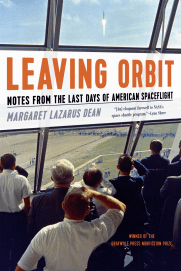
Book Review: “Leaving Orbit” by Margaret Lazarus Dean

First came the Apollo era. Following Sputnik and Yuri Gagarin, the first satellite and human in space, the United States leaped into the space race. Within 11 years of NASA’s formation, and with incredible public support, they managed to launch Neil Armstrong and Buzz Aldrin to the surface of the moon. The moon!
9781555977092

Then came the space shuttle era, also a time of lofty and grand missions. NASA astronauts flew the shuttles on 135 missions, to deploy space probes like the Hubble Space Telescope and to assemble the International Space Station. But all good things must come to an end, as they say. Margaret Lazarus Dean, in her new book, Leaving Orbit: Notes from the Last Days of American Spaceflight, witnesses and chronicles the final flights of the Discovery, Endeavour and Atlantis shuttles in 2011. For each of those three shuttles, she describes the visceral experience of watching the launches and landings, including the responses of diverse fellow onlookers at Cape Canaveral on the coast of Florida.

Dean reflects on the space shuttle program’s many impressive achievements, as well as its shortcomings and failures, in the case of the tragic explosion of Challenger in 1986 and the breakup of Columbia in 2003. (She previously wrote a novel about the Challenger disaster.) Throughout the book, she provides a record of a wide range of people grappling with the end of the era and wondering about what might come next.
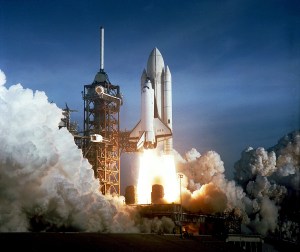
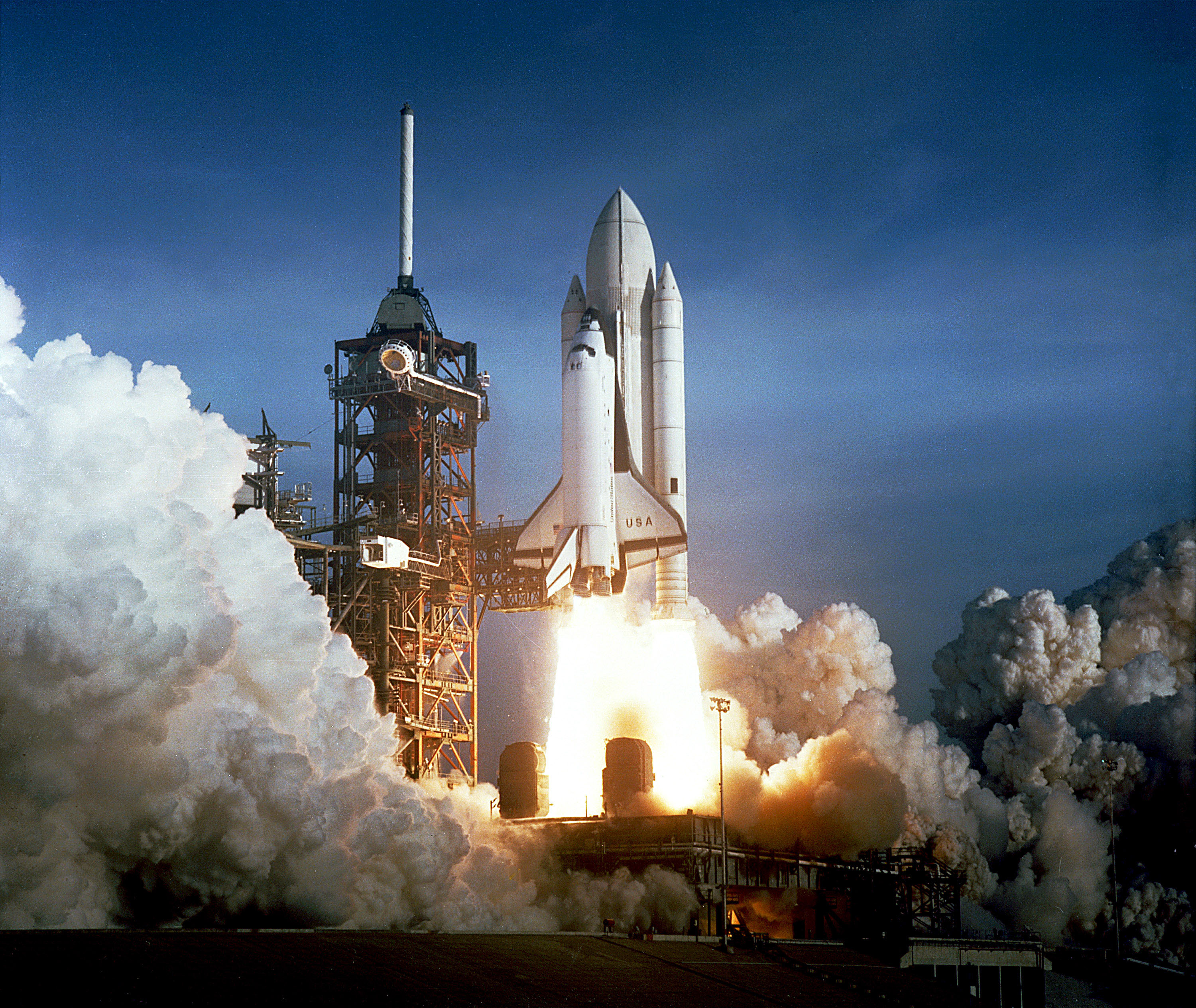
Space shuttle Columbia lifts off from Launch Pad 39A on 12 April 1981. (Credit: NASA)

Space shuttle Columbia lifts off from Launch Pad 39A on 12 April 1981. (Credit: NASA)

She encounters both aspiring and accomplished astronauts—she’s starstruck as she meets Aldrin (and I don’t blame her). Dean also talks to space workers, as well as other writers and journalists, who are all somehow trying to figure how to put these momentous events into words. She makes many references to iconic writers, during what she considers the pinnacle of American spaceflight. Especially Norman Mailer (author of Of a Fire on the Moon), Tom Wolfe (The Right Stuff) and Oriana Fallaci (If the Sun Dies) clearly influenced her.

Dean sprinkles many telling and intriguing anecdotes throughout the book. At one point she quotes a conversation she overheard, in which a NASA public affairs person corrects a Reuters journalist, saying that it’s not the end of American spaceflight, but “the end of American spaceflight as we know it,” which seems to be a subtle distinction. She also points out that in spite of NASA currently accounting for a small fraction of the national budget, her university students overwhelmingly overestimated how much funding the agency actually receives. It gets about 0.4% of the national budget, but most of her students guessed it was more than one fifth! Maybe that demonstrates NASA’s ability to have a big impact and inspire the public imagination with relatively few resources.

NASA's logo, often affectionately referred to as the "meatball." (People refer to its less popular logo in the '80s as the "worm.")

NASA’s logo, often affectionately referred to as the “meatball.” (People refer to its less popular logo in the ’80s as the “worm.”)

Dean’s book is more a memoir than anything else. It’s often fascinating to read, but it feels too wordy and verbose at times. She includes far too many mundane or irrelevant details, including the drive to and from Florida, the motels she stays at (one reference to Mailer is enough there), and numerous texts and social media posts. Omar Izquierdo, a NASA technician, host and new friend, makes for an interesting character, but every single interaction with him doesn’t need to be included. It’s as if she documented in detail every step she took and every thought that popped in her head and shoehorned them in. She also writes many times about her husband and child, who made sacrifices so that she could make these trips; she raises important concerns, but they would belong more in a book more directly touching on work-life balance and gender equality. She and her editors could have cut 100 pages from this book, in my opinion, strengthening its impact without losing any substance.

A few times—maybe a few too many—Dean writes self-referentially about her own book. (Such a device can be effective in a comedy like The Muppet Movie, but I’m not sure how well it works here.) The point, it seems, is to pose a question to herself as much as to others involved in the shuttle program and commercial spaceflight: “I’m asking what it means that we went to space for fifty years and have decided not to go anymore,” she writes.

Dean’s book seems slightly late: it was probably written in 2011 and includes few developments since then. She briefly mentions NASA’s Space Launch System and Orion—scheduled to be launched in an uncrewed mission in 2018—and she describes SpaceX and other spaceflight companies, but this feels tacked on at the end.

I understand her skepticism about commercial spaceflight, and I share many of her concerns. She has three main criticisms: First, the big and daring spaceflight projects that she and many others support are, by definition, not good investments. “They are exploratory, scientific, ennobling, and expensive, with no clear end point and certainly no chance of making a profit.” Second, as long as spaceflight is run by a government agency, she says, any child can reasonably dream of flying in space one day. Third, it’s been part of NASA’s mandate to make its projects available to the public, but private companies have no such obligation.

I don’t think Dean means to diss NASA, but it does seem that way toward the end, as she seems to think ending the shuttle program was a huge mistake. But what’s done is done, and without the shuttle, NASA continues to accomplish a lot. In the past year alone, it deployed a satellite to study Ceres, the only dwarf planet in the asteroid belt; it flung a probe past Pluto, giving us the most detailed images ever of our diminutive cousin; it sent a spacecraft to observe Saturn’s moon Enceladus; and it recently completed a yearlong study of the astronaut twins, Mark and Scott Kelly.

Later in the book, she argues cynically (and to some extent, correctly, in my view) that support for the space program started as an accident, because of Sputnik, a new president, the Cold War, and German rocket designers like Wernher von Braun who fled to the U.S. instead of the Soviet Union.

In the end, however, her reflection turns into an almost obsessive nostalgia for a glorious past. This stifles our ability to take stock of where we are right now and how we got here, and then focus our efforts to plan and prepare for what comes next, which might include returning to the moon, journeying to Mars, and exploring beyond our solar system. Dean’s patriotism limits her too: space exploration requires international collaboration; it isn’t just by or for blue-blooded Americans. It’s for all people who want to join the party, including Russians, Chinese, Europeans, and everyone else.

Mourn the shuttle era in your own way, but then let’s move on with our lives and make the most of our current national and international space programs. We have lots of brilliant, clever and talented people and powerful tools to work with, and if we set our minds to it, our days of exploring space, including launching more people into the skies, will be far from over.

More News from Monterey: Otter Rescue, Coastal Economy, Fog Maps

Here’s a few new stories I reported on and wrote for the Monterey Herald newspaper over the past couple weeks:


Helping otter pups survive El Niño

When a stranded sea otter baby was rescued on Carmel Beach by Monterey Bay Aquarium workers in January, it was a rare enough event to be featured on the television news.

But with more El Niño-strengthened rainstorms returning to the Monterey Bay, these rescues might become more commonplace.

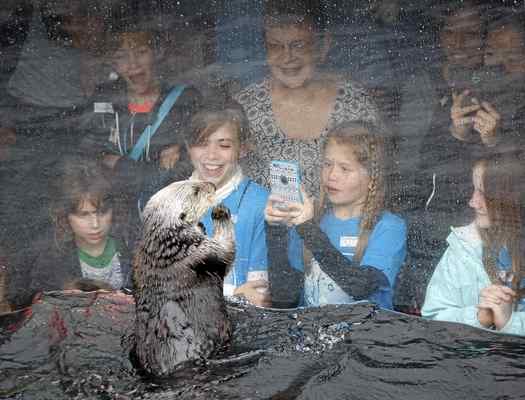
Monterey Bay Aquarium visitors enjoy the sea otter exhibit during the 1:30 feeding at the Monterey Bay Aquarium on Friday. (Vern Fisher - Monterey Herald)

Monterey Bay Aquarium visitors enjoy the sea otter exhibit during the 1:30 feeding at the Monterey Bay Aquarium on Friday. (Vern Fisher – Monterey Herald)

Storms increase the potential for pups to be separated, said Tim Tinker, a biologist for the U.S. Geological Survey and UC Santa Cruz. Otters like to feed closer to shore in shallower water, where the waves are bigger during El Niño. Storms also rip up kelp forests, giving the animals less shelter and resting areas, he added.

Only a few otters have been rescued so far this year, said Andrew Johnson, manager of the aquarium’s Sea Otter Program. “We’re holding our collective breath about the effect of conditions out there.”

Most pups are born between late fall and early spring, and they require many months of nursing and weaning. Adult otters spend much of their time foraging for food, as they need to eat 25 percent of their body weight every day. But an otter mother can’t forage as much and becomes weak by the end of the weaning period.

“She’s on the razor’s edge. It sounds pretty harrowing, but that’s the way they are,” said Tinker. Storms can split up otter pups from their mothers during this particularly vulnerable period. On their own, pups struggle to survive and don’t have much time before they starve or freeze to death.

This is where the aquarium’s sea otter rescue program comes in. Often responding to calls from citizens and networks of volunteers, their staff annually rescue dozens of distressed otters stranded on the shore. Sometimes a pup can be heard before it is seen, chirping or squeaking for its lost mother. In addition to suffering from food limitations, older otters are sometimes found to be sick with disease or injured by white sharks.

When the animals meet certain criteria and respond well to treatment, then the rescue program adopts them. Staff members feed and care for the otters in giant circular tanks, filled with kelp and companions, with plenty of room to swim, play and rest. They pair the pups with a surrogate mother, who helps them grow and learn to survive on their own. After they recuperate, which can take months, the otters are tagged and released back into the wild. “We want them to go out and be a productive member of sea otter society,” said Johnson…

[For more, check out the entire story in the Monterey Herald, published on 5 March 2016. As usual, thanks to David Kellogg for editing assistance and to Vern Fisher and David Royal for their excellent photography.]

Continue reading